Aun vs Aún: The Simple Tilde Rule Spanish Learners Need
Write “aún” with a tilde when it means “todavía” (still, yet); write “aun” without one when it means “incluso” (even) or forms a concessive phrase like “aun…

Write “aún” with a tilde when it means “todavía” (still, yet); write “aun” without one when it means “incluso” (even) or forms a concessive phrase like “aun así.” The fastest check is the substitution test: swap in “todavía.” If the sentence still makes sense, you need the tilde. If it does not, drop it.
- With tilde: Aún no ha llegado. (She still hasn’t arrived.) Swap in “todavía” and the sentence works perfectly.
- Without tilde: Aun los niños lo entendieron. (Even the kids understood it.) Try “todavía” here and the sentence falls apart, because the meaning is “even,” not “still.”
That one test resolves most confusion instantly, but understanding why it works will make the rule stick for good.
Key Takeaways
The tilde on “aún” marks a stressed hiatus meaning “still,” while unaccented “aun” is an unstressed diphthong meaning “even” or part of a fixed concessive phrase.
| Point | Details |
|---|---|
| Use the substitution test | Swap in “todavía”: if the sentence still works, write “aún” with a tilde. |
| Listen for stress | Two vowel sounds ([a.ún]) signal a tilde; one blurred syllable ([aun]) signals no tilde. |
| Memorize fixed locutions | “Aun cuando,” “aun así,” and “ni aun” are always written without a tilde. |
| Watch for media errors | FundéuRAE regularly corrects misplaced tildes on “aun así” in published writing. |
| Drill it daily | Gramanator’s targeted grammar exercises turn this rule into automatic recall through repetition and instant feedback. |
Table of Contents
- Why Does Aun vs Aún Need a Tilde at All?
- When to Write Aún With a Tilde
- When to Write Aun Without a Tilde
- A Quick Cheat Sheet: 3 Steps to Decide
- How to Train This Until It’s Automatic
- Turn This Rule Into Instinct With Gramanator
- Frequently Asked Questions
- Sources
Why Does Aun vs Aún Need a Tilde at All?
The tilde isn’t arbitrary. It follows Spanish’s ordinary accentuation rules, the same ones that decide whether “país” needs a mark or “pais” wouldn’t. When you stress the “ú” and pronounce the word as two distinct syllables, [a.ún], you get a hiato (hiatus), a break between two vowels that each keep their own beat. That stressed hiatus takes the tilde. When the word collapses into a single, unstressed syllable, [aun], the “a” and “u” glide together into a diptongo (diphthong), and diphthongs in an atonic (unstressed) position don’t carry a written accent.
Both the Real Academia Española and FundéuRAE treat this as standard accentuation, not a special diacritic pair like “sí” and “si.” A few things nudge pronunciation one way or the other, which is worth knowing before you assume every case is clear cut:
- The meaning you intend (temporal versus inclusive) often decides the stress before you even open your mouth.
- Where the word falls in the sentence can shift emphasis.
- Speaking quickly tends to blur the hiatus into a diphthong.
- Regional accents vary in how sharply speakers separate the two vowels, a point Wikilengua notes explains some of the apparent inconsistency you’ll hear.
When to Write Aún With a Tilde
You reach for the accented form in three main situations, all sharing one trait: the word carries stress. According to FundéuRAE, the tilde belongs in temporal, adversative, and emphatic uses.
- Temporal (still/yet): Aún quedan entradas. (There are still tickets left.) Substitute “todavía” and it reads naturally.
- Adversative (however/nevertheless): Le sirvieron la comida y aún se quejó. (They served him the meal and he still complained.) The sense is closer to “and yet,” which “todavía” captures.
- Emphatic or ponderative (often with comparatives): Este modelo tiene aún más potencia. (This model has even more power.) Here “aún” intensifies “más,” and “todavía” slots right in: “todavía más potencia.”
- Question form: ¿Aún no has terminado? (Haven’t you finished yet?) Again, “todavía” fits without changing the meaning.
- With adverbs of degree: Aún mejor sería esperar. (It would be still better to wait.)
Some sentences look ambiguous on paper, readable as either “still” or “even.” FundéuRAE advises that when both readings seem possible, the tonic pronunciation the speaker intends usually settles it. If you’d stress it aloud, write the tilde.
When to Write Aun Without a Tilde
Drop the tilde when “aun” functions like “incluso,” “hasta,” or “siquiera,” or when it’s locked into a concessive phrase. In every one of these cases, the word is atonic. Say the sentence out loud and “aun” barely registers as its own beat.
- Inclusive/ponderative: Aprobaron todos, aun los que no estudian nunca. (Everyone passed, even those who never study.)
- Conditional inclusion: Te lo darán aun cuando no lo pidas. (They’ll give it to you even if you don’t ask.)
- Concessive, standalone: Es una buena oferta y, aun así, no firmará. (It’s a good offer, and even so, he won’t sign.)
- Negative emphasis: Ni aun con ayuda terminó a tiempo. (Not even with help did he finish on time.)
- Gerund/participle concession: Aun sabiendo la respuesta, se quedó callado. (Even knowing the answer, he stayed silent.)
Three fixed locutions are worth memorizing outright, since they show up constantly and never take a tilde: aun cuando, aun así, and ni aun, all confirmed as unaccented forms in the Diccionario panhispánico de dudas.
Newsrooms get this wrong often enough that FundéuRAE has issued repeated corrections, most commonly adding a tilde to “aun así” when the phrase should stay unaccented. If professional editors slip on this, it’s worth double-checking your own writing rather than trusting instinct alone.
A Quick Cheat Sheet: 3 Steps to Decide
When you’re mid-sentence and unsure, run through this sequence. It takes about three seconds once it’s automatic.
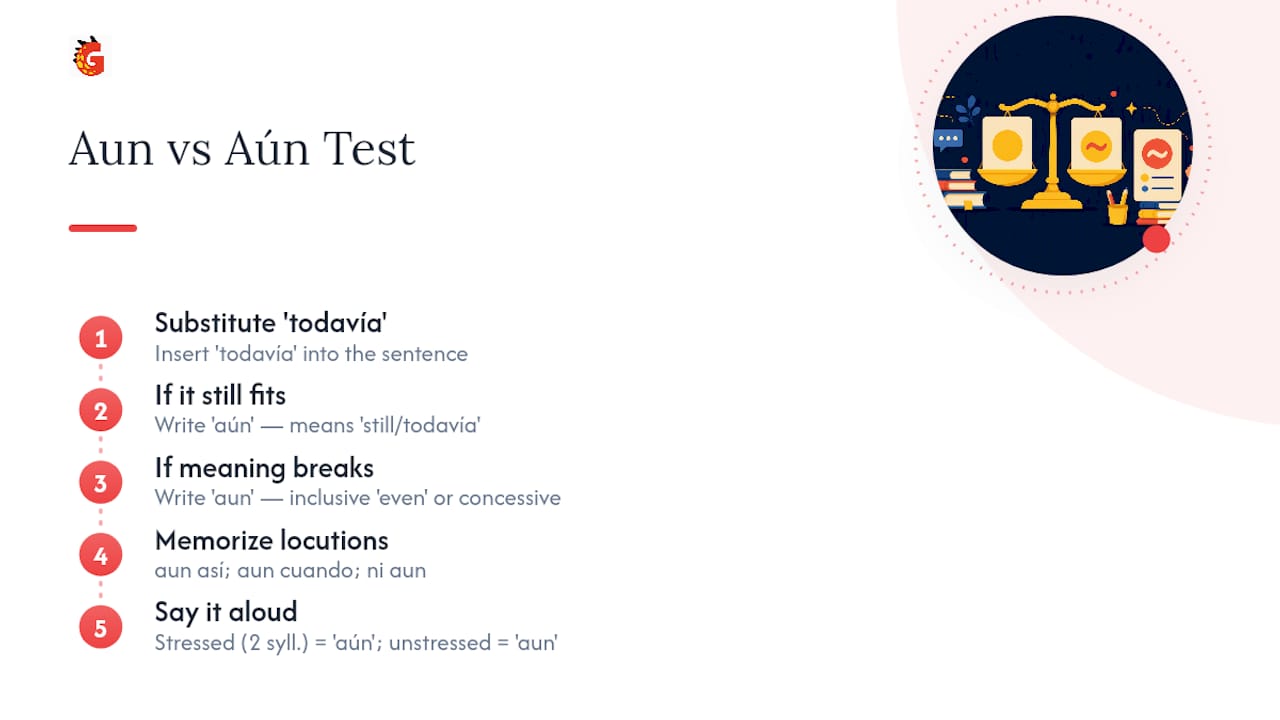
- Substitute “todavía.” Aún tengo hambre → Todavía tengo hambre. Works, so it’s “aún.”
- Listen for stress. Say the word aloud. If you hear two separate vowel sounds ([a.ún]), it’s tonic and needs the tilde. If it blurs into one syllable ([aun]), skip the mark.
- Check for “even” or a locution. Aun los expertos se equivocan means “even the experts,” so no tilde, and no “todavía” swap works here either.
Pro Tip: Whisper the sentence instead of reading it silently. Whispering forces you to actually produce the stress pattern, which makes the hiatus versus diphthong distinction far easier to hear than just eyeballing the word on a page.
How to Train This Until It’s Automatic
Reading the rule once won’t make it stick under pressure, when you’re typing fast or speaking without time to think. Treat it like a grammar pattern you drill, not a fact you memorize.
A 5 to 10 minute daily routine works better than an occasional deep review:
- Run five substitution drills, swapping “todavía” into sentences to test whether the tilde belongs.
- Rewrite three sentences that use “aun,” changing the context so they’d require “aún” instead, and vice versa.
- Produce your own sentences: write three using “aún” and three using “aun,” covering at least one fixed locution.
This kind of targeted, mistake-focused repetition is exactly how automatic recall gets built, the same principle behind training subordinate clauses or common conditional tense errors. Professionals who write in Spanish for work face this constantly in email and reports, where tone and precision both matter, a point echoed in why accurate Spanish tone affects client relationships.
Turn This Rule Into Instinct With Gramanator
Knowing the substitution test is one thing. Applying it correctly at full speaking speed, without pausing to think “todavía or incluso?”, is a different skill entirely, and it only comes from repetition under real conditions.
Gramanator is built around exactly that gap between knowing a grammar rule and reacting with it automatically. Inside the platform, you get targeted drills built for tricky orthography like this, immediate feedback the moment you choose wrong, and progress tracking that flags whether “aun vs aún” is still a weak spot or one you’ve locked in. Instead of rereading the rule, you produce sentences, get corrected instantly, and repeat until the choice stops requiring conscious thought. If you’re ready to stop hesitating over accents mid sentence, start a Gramanator practice session and put this rule through real drills today.
Frequently Asked Questions
Is there a simple trick to remember aun vs aún? Yes. Substitute “todavía” into the sentence. If it still makes sense, write “aún” with a tilde. If the meaning shifts or breaks, write “aun” without one.
Does aun sin tilde ever mean “still”? No. Unaccented “aun” always carries an inclusive sense (“even,” “hasta”) or appears in a fixed concessive phrase. “Still” or “yet” always requires the tilde.
Why doesn’t “aun así” take a tilde if it sounds emphatic? Because “aun así” is a fixed concessive locution, not a temporal use. It’s pronounced as an unstressed diphthong, so the Diccionario panhispánico de dudas confirms it stays unaccented, despite frequent media errors adding one.
Can the same sentence take either form depending on meaning? Occasionally. If a sentence could plausibly mean “still” or “even,” the intended stress decides the spelling. Say it aloud: stressed and two-syllabled means “aún,” blurred and one-syllabled means “aun.”
What are the most important locutions to memorize? Aun cuando, aun así, and ni aun are the three most common fixed, unaccented phrases. Memorizing them prevents most of the tilde errors learners and even professional writers tend to make.
Sources
- «aún» equivale a «todavía», «aun» a «incluso» | FundéuRAE
- La tilde en aún/aun | Ortografía de la lengua española | RAE - ASALE
- aun | Wikilengua