What is Spanish customer service grammar? A complete guide
Master Spanish customer service grammar. Polite formulas, conditional softeners, and usted forms for calls, chat, and in-person work.

If you have ever tried to help a customer in Spanish and felt unsure whether to say “¿Puedo ayudarte?” or “¿Puedo ayudarle?”, you are already asking the right question. Understanding what is Spanish customer service grammar means knowing how to shift between politeness levels, choose the correct verb forms, and construct requests that sound professional rather than blunt. This guide walks you through the core grammar rules you need: the formal versus informal address system, conditional tense for polite requests, clarification phrases, and the most common mistakes learners make. By the end, you will have a clear, practical framework for real-world Spanish service communication.
Table of Contents
- Understanding formal and informal grammar in Spanish customer service
- Making polite requests: using conditional and indirect structures
- Clarification and conversational flow in Spanish customer service interactions
- Common challenges and expert tips for mastering Spanish customer service grammar
- The hidden key to mastering Spanish customer service grammar
- Practice and master Spanish customer service grammar with Gramanator
- Frequently asked questions
Key Takeaways
| Point | Details |
|---|---|
| Formal vs informal grammar | Spanish customer service grammar requires careful use of tú and usted with matching verbs and pronouns. |
| Use conditional tense | The conditional tense is the primary choice for polite and professional requests in Spanish. |
| Polite clarifications | Master phrases for asking repetition or pauses to maintain professionalism during conversations. |
| Consistency matters | Avoid mixing formal and informal grammar within the same interaction to sound professional. |
| Practice with purpose | Targeted grammar practice helps internalize polite customer service communication patterns. |
Understanding formal and informal grammar in Spanish customer service
The Spanish formal register guidance explains this well: what is Spanish customer service grammar, at its core, is two things. First, the politeness register, which means choosing between tú (informal) and usted (formal). Second, the indirect request structures that help you sound professional. These two elements shape almost every sentence you say to a customer.
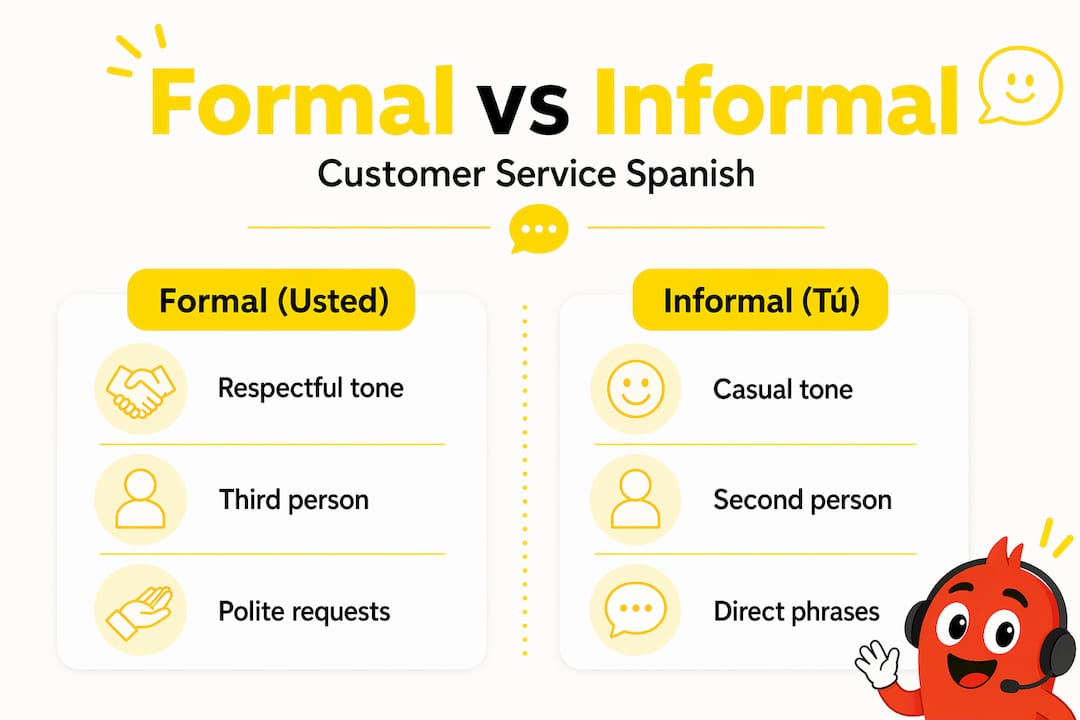
In customer service, usted is the default. It signals respect, and it changes your entire grammar, not just the pronoun you use.
Here is what shifts when you move from tú to usted:
| Grammar element | Tú (informal) | Usted (formal) |
|---|---|---|
| Verb person | 2nd person singular | 3rd person singular |
| Verb example: “to have” | tú tienes | usted tiene |
| Verb example: “to want” | tú quieres | usted quiere |
| Object pronoun (indirect) | te | le |
| Object pronoun (direct) | te | lo / la |
| Possessive adjective | tu pedido (your order) | su pedido (your order) |
Notice that usted uses third-person verb forms. That surprises many learners. You are saying “you want” but conjugating the verb as if you are saying “he wants.” This is one of the most common points of confusion in business Spanish grammar rules.
Here are some practical examples of the same phrase in both registers:
-
Tú: ¿Tienes tu número de pedido? (Do you have your order number?)
-
Usted: ¿Tiene su número de pedido? (Do you have your order number?)
-
Tú: Te voy a ayudar con eso. (I am going to help you with that.)
-
Usted: Le voy a ayudar con eso. (I am going to help you with that.)
The meaning is identical. The register is completely different. A common learner error is saying “Te voy a ayudar” while calling a customer usted in the same sentence. That mix sends a confusing signal to any native speaker.
You can find more real-world grammar patterns organized by scenario on the Spanish grammar blog, which is a useful companion as you build your professional vocabulary.
With a solid grasp of the formal versus informal address system, let’s explore how this affects making requests in Spanish customer service.
Making polite requests: using conditional and indirect structures
Direct imperatives work in everyday conversation, but in customer service Spanish they can land too hard. Telling a customer “Espere.” (Wait.) is grammatically correct but socially jarring. The Spanish formal requests explained resource confirms that conditional forms are the standard for polite requests in modern professional Spanish.

The conditional tense is your main tool here. It softens any request by framing it as hypothetical rather than direct. Think of it as the grammatical equivalent of saying “would” in English.
Key phrases to know:
- Podría (Could you / Could I) - the workhorse of customer service Spanish
- Desearía (I would like) - used when you are offering help or expressing a preference
- Le agradecería (I would appreciate it if you) - used when asking a customer to do something
Here are those phrases in context:
- ¿Podría darme su nombre completo? (Could you give me your full name?)
- Desearía ayudarle con su solicitud. (I would like to help you with your request.)
- Le agradecería que confirmara su dirección. (I would appreciate it if you confirmed your address.)
Notice that last phrase. Le agradecería que confirmara uses the subjunctive mood (confirmara) after the conditional. This structure, conditional plus subjunctive, is the gold standard for polite, indirect customer service language tips in Spanish. It sounds formal without sounding cold.
- Imperative (avoid in most cases): Confirme su dirección. (Confirm your address.)
- Conditional + subjunctive (preferred): Le agradecería que confirmara su dirección. (I would appreciate if you confirmed your address.)
Both sentences ask for the same thing. The second version shows cultural sensitivity, which matters enormously in Spanish-speaking professional settings.
Pro Tip: If the conditional plus subjunctive feels too advanced right now, start with ¿Podría...? for every request. It is the most natural and versatile option in Spanish customer support phrases, and native speakers use it constantly.
The polite request grammar tips section on the Gramanator blog offers focused exercises if you want to practice these structures in context.
Now that you understand the key polite grammar for requests, let’s examine how to keep customer service conversations clear and courteous through clarifications and turn-taking.
Clarification and conversational flow in Spanish customer service interactions
Even experienced speakers need clarification tools. Asking for repetition or more time is not a weakness; in customer service, it is professional. The key is doing it with the right phrases so you maintain confidence and warmth at the same time.
According to customer service communication tips, learners working on Spanish service communication should build a small set of go-to clarification phrases. Here is a step-by-step approach you can apply to real interactions:
- Signal that you did not fully understand: Perdón, no entendí completamente. (Sorry, I did not fully understand.)
- Ask for repetition: ¿Podría repetir, por favor? (Could you please repeat that?)
- Ask them to slow down: ¿Podría hablar un poco más despacio, por favor? (Could you speak a little more slowly, please?)
- Buy yourself a moment: Un momento, por favor. (One moment, please.)
- Confirm your understanding: Si entendí correctamente, usted dice que... (If I understood correctly, you are saying that...)
- Transition smoothly: Con mucho gusto le ayudo con eso. (I am happy to help you with that.)
Each of these phrases uses the grammar structures from the previous sections. Notice that ¿Podría repetir? is the conditional again. The same patterns repeat across customer interactions because they are grounded in real, polite clarification requests that Spanish speakers recognize immediately as professional.
Pro Tip: Confirmation sentences like “Si entendí correctamente...” do double duty. They verify that you understood, and they give the customer a chance to correct you before you take action. This prevents costly miscommunications in customer support contexts.
Cultural note: In many Spanish-speaking regions, silences during customer interactions are read as uncertainty or indifference. Time-buying phrases like “Un momento, por favor” or “Permítame verificar eso” (Allow me to check that) fill the pause professionally and signal that you are actively working on the issue.
Having explored key conversation management tools, let’s review common learner challenges and how expert knowledge sharpens your professional Spanish customer service grammar.
Common challenges and expert tips for mastering Spanish customer service grammar
Most grammar errors in Spanish service communication come from one root cause: treating usted as just a swap-out word rather than a grammar switch. You cannot simply replace tú with usted and leave everything else the same.
Here is what you must shift all at once when moving to formal register:
- The pronoun: tú → usted
- The verb conjugation: 2nd person → 3rd person
- The indirect object pronoun: te → le
- The direct object pronoun: te → lo or la
- The possessive adjective: tu → su
Missing any one of these creates a grammar inconsistency that sounds off to native speakers, even if they cannot immediately identify why.
“For professional support work, prioritize softened agency grammar: avoid direct imperative phrasing for normal requests and use conditional and subjunctive-based indirect structures instead. In practice, this reduces perceived bluntness during clarifications, as phrases like Podría... or Le agradecería... soften the request even when you must ask the customer to do something.” Formal requests grammar insights
Additional challenges to watch for:
- False formality: Using usted but still saying “¿tienes?” instead of “¿tiene?” is a very common near-miss.
- Overusing imperatives: Even gentle imperatives like “Dígame” (Tell me) should be used sparingly. “¿Podría decirme...?” is almost always more appropriate.
- Skipping the subjunctive: Phrases like “Le agradecería que confirma” use the indicative (confirma) when the subjunctive (confirmara) is required after a conditional structure in a formal request.
You can explore structured grammar practice plans designed specifically to help you drill these formal register patterns until they become second nature.
With these expert strategies in mind, let’s reflect on what these insights mean for your real-world Spanish customer service communication.
The hidden key to mastering Spanish customer service grammar
Here is something that most grammar guides skip over: fluency in Spanish service communication is not about memorizing phrases. It is about internalizing formality as a reflex, not a checklist.
When you first learn the tú versus usted distinction, you probably approach it consciously. You remind yourself to change the verb, switch the pronoun, check the possessive. That process works, but it is slow. And in a real customer interaction, slow grammar is a problem.
The Spanish formal register learning insight makes an important point: once usted grammar is internalized, it becomes automatic. Experts warn it feels counterintuitive at first, because you are saying “you” but conjugating for “he.” That friction does not disappear through explanation. It disappears through repetition.
The same applies to softened requests. When you stop thinking of ¿Podría...? as a polite formula and start feeling it as the natural, respectful way to speak to someone in a professional setting, your insider Spanish grammar tips knowledge moves from your head to your mouth. That is when real fluency begins.
There is also a deeper cultural point here. In Spanish-speaking professional environments, softened language is not just about following rules. It signals that you see the customer as a person deserving of genuine respect, not just a transaction. Grammar is the vehicle for that signal. Getting the forms right matters precisely because the forms carry meaning.
Think of grammar not as a set of rules to comply with, but as a set of tools to communicate respect, clarity, and professionalism. That shift in mindset changes everything about how you practice.
Practice and master Spanish customer service grammar with Gramanator
Understanding the rules is the first step. Internalizing them takes practice, and that is exactly what Gramanator is built for. Whether you are at A1 or approaching C1, Gramanator’s Spanish grammar practice exercises target the specific patterns that matter most in professional and service communication, including formal register shifts, conditional tense requests, and polite clarification structures.
Gramanator gives you over 10,000 interactive exercises built around real-world scenarios, including customer service, travel, and workplace communication. Every exercise includes detailed grammar explanations, hints, and mistake analysis so you understand why each form is correct, not just what the answer is. You can track your progress, review weak areas, and follow personalized recommendations that match your current level. Explore the options available and find a plan that fits your learning goals.
Frequently asked questions
What is the difference between tú and usted in Spanish customer service?
Tú is informal and uses second-person verb forms, while usted is formal, using third-person forms and different object pronouns, making it the standard choice for polite customer service communication.
Why is the conditional tense important in Spanish customer service requests?
The conditional tense softens requests, making them polite and indirect. Conditional forms like podría, desearía, and le agradecería are the standard for professional Spanish customer interactions.
How can I politely ask for clarification in Spanish customer service?
Use phrases like “Perdón, no entendí completamente,” “¿Podría repetir, por favor?” or “Un momento, por favor” to manage clarifications politely and keep the interaction professional.
What common mistakes should learners avoid in Spanish customer service grammar?
Avoid mixing tú and usted forms inconsistently, especially with object pronouns and verb conjugations. Also avoid direct imperatives in favor of conditional and subjunctive-based requests, which sound far more professional to native speakers.