Master Pronominal Verbs in Spanish: 3 10 minute Sessions for Learners
A verbo pronominal is a verb conjugated with the unstressed pronouns me, te, se, nos, or os, which agree with the subject and can either receive the action…
A verbo pronominal is a verb conjugated with the unstressed pronouns me, te, se, nos, or os, which agree with the subject and can either receive the action or simply mark a shift in meaning. The practical takeaway: never treat every one of those pronouns as a straightforward object like “myself” or “yourself.” Some genuinely are. Others quietly change a verb’s whole behavior. Learning to tell the difference is what actually moves your Spanish forward.
TL;DR:
- Recognizing whether a pronominal verb is reflexive, reciprocal, inherent, or change-of-state guides correct usage and impacts how the verb behaves without the pronoun.
- Adding se can change a verb’s meaning from a direct action to a spontaneous or emphasized event, often requiring prepositions like de or a depending on context.
- Practice should focus on contrastive drills and recognition, especially for verbs that shift meaning or require specific prepositions, to develop automatic pronunciation and application.
- Regional and register differences influence pronominal verb use, but core grammatical patterns are consistent across Spanish-speaking regions and other Romance languages.
Table of Contents
- What Is a Verbo Pronominal in Español?
- How Are Pronominal Verbs Classified?
- Why Does Adding “se” Change a Verb’s Meaning?
- Common Pronominal Verbs and Example Sentences
- How Should You Practice Pronominal Verbs?
- Where Do Pronominal Verbs Come From?
- How Do Pronominal Verbs Behave in a Sentence?
- Do Pronominal Verbs Change Across Spanish Dialects?
- How Do Other Romance Languages Handle Reflexive Verbs?
- Turn This Explanation Into Real Speaking Instinct
- Sources
What Is a Verbo Pronominal in Español?
The Real Academia Española defines pronominal verbs as verbs that require an unstressed reflexive pronoun agreeing with the subject in person and number. That agreement is the first thing to lock in, because it never changes shape:
- Yo me lavo (I wash myself)
- Tú te levantas (You get up)
- Él se preocupa (He worries)
- Nosotros nos quejamos (We complain)
- Vosotros os arrepentís (You all regret it)
- Ellos se aburren (They get bored)
Notice something odd about preocuparse, quejarse, arrepentirse, and aburrirse: you can’t strip the pronoun off and still have a normal sentence. Say “él preocupa” and a Spanish speaker will wait for you to finish the sentence, because preocupar needs an object. That’s the split you’ll keep running into. Some pronominal verbs are truly reflexive (the subject acts on itself). Others are pronominal by nature, with the pronoun baked permanently into the verb’s identity.
How Are Pronominal Verbs Classified?
Spanish grammar doesn’t lump every “se verb” into one basket, and treating them that way is exactly the habit that trips up intermediate learners. The RAE’s own glossary warns explicitly against calling all pronominal verbs “reflexive,” because many of those pronouns are non-argumental markers rather than objects standing in for the subject. Here’s the taxonomy worth memorizing:
- Reflexive: the subject performs the action on itself. Me ducho (I shower myself). Test: can you insert “a sí mismo” without sounding strange? If yes, it’s reflexive.
- Reciprocal: two or more subjects act on each other. Se abrazaron (They hugged each other). Test: does “el uno al otro” fit naturally? That confirms reciprocity.
- Inherent or pronominal-only: the verb simply doesn’t exist without se. Arrepentirse, atreverse, jactarse. Test: try dropping the pronoun. If the sentence collapses or means something entirely different, it’s inherent.
- Anticausative or medio (change of state): the subject undergoes a change with no external agent named. La puerta se abrió (The door opened). Test: is there an implied “by itself,” with no one doing the opening?
- Cuasirreflexive and other pragmatic uses: the pronoun adds emphasis, totality, or a shift in aspect without a true reflexive meaning. Se comió toda la pizza (He ate the whole pizza). Test: does removing se still leave a grammatical, nearly identical sentence? Then it’s this weaker, emphatic use.
Pro Tip: When you hit a new “se verb,” run it through the tests above in order. If none of the reflexive or reciprocal tests fit and dropping se breaks the sentence, you’ve found an inherent pronominal verb, and the smartest move is to memorize it as one unit rather than analyze it.
Why Does Adding “se” Change a Verb’s Meaning?
This is where most learners get quietly derailed, because English doesn’t do this the same way. Adding or removing the pronoun in Spanish frequently changes not just the tone of a sentence but its grammatical requirements.
Take olvidar versus olvidarse. “Olvidé el libro” (I forgot the book) treats forgetting as something you did to the book directly. “Me olvidé del libro” reframes the same event as something that happened to you, and now the verb demands the preposition de before its object. Miss that de and the sentence sounds foreign even though every word is technically Spanish.
The same pattern shows up in some of the most common verb pairs learners mix up:
- Ir vs. irse: Voy a la tienda (I’m going to the store, destination matters) versus Me voy (I’m leaving, the departure itself is the point).
- Quedar vs. quedarse: Quedamos a las ocho (We agreed to meet at eight) versus Me quedé en casa (I stayed home).
- Dormir vs. dormirse: Duermo ocho horas (I sleep eight hours, a state) versus Me dormí en el sofá (I fell asleep, an event with a starting point).
- Caer vs. caerse: El precio cayó (The price fell, gradual) versus Me caí en la calle (I fell down, a sudden physical event).
A quick syntactic test settles whether se is a true object or just a marker: ask if the pronoun can be replaced with “a sí mismo” or a full noun phrase without changing the verb’s core meaning. If it can, you’re looking at a genuine reflexive object. If replacing it breaks the sentence or the meaning shifts entirely, se is functioning as a non-argumental marker, exactly the distinction the RAE’s terminology guide insists on. Getting this test automatic in your head does more for your fluency than memorizing another hundred verbs.
Common Pronominal Verbs and Example Sentences
Building a working list is more useful when it’s grouped by function rather than alphabetized, since recognizing the category tells you what test to apply. Spanish grammar resources typically group pronominal verbs by sense/17/17.05_Verbos_pronominales): reflexive, reciprocal, anticausative, impersonal or medio, and inherent.
Inherent pronominal verbs (never appear without se):
- Me arrepiento de haberlo dicho. (I regret having said it.)
- Se atrevió a preguntar. (He dared to ask.)
- Nos jactamos de nuestro trabajo. (We boast about our work.)
Alternating verbs (meaning shifts with or without se):
- Se dio cuenta del error. (She realized the mistake.) vs. Dio el regalo. (She gave the gift.)
- Se fue temprano. (He left early.) vs. Fue al mercado. (He went to the market.)
Reciprocal verbs:
- Se conocieron en Madrid. (They met each other in Madrid.)
- Nos escribimos cada semana. (We write to each other every week.)
Change of state verbs:
- El hielo se derritió al sol. (The ice melted in the sun.)
- La leche se echó a perder. (The milk went bad.)
| Group | Sample verb | Quick tip |
|---|---|---|
| Inherent | arrepentirse | Never drop the se |
| Alternating | darse cuenta | Watch for the required “de” |
| Reciprocal | conocerse | Look for “each other” in English |
| Change of state | derretirse | No one is doing it on purpose |
How Should You Practice Pronominal Verbs?
Recognition is only half the job. Getting the right pronoun to come out automatically when you’re mid-conversation requires a different kind of practice than reading grammar rules, and teachers who use contrastive drills consistently see fewer transfer errors than learners who just memorize verb lists.
- Contrastive sentence transformation: take one verb and write both forms back to back (durmió / se durmió) until the difference feels automatic rather than theoretical.
- Fill-in-the-blank with pronoun choice: practice sentences where you must decide whether se belongs at all, not just where to place it.
- Timed recall drills: set sixty seconds to produce five sentences using a specific alternating verb pair under light pressure.
The five errors that show up most often: dropping se from inherent verbs, forgetting the required preposition after verbs like olvidarse de or darse cuenta de, misplacing the pronoun with infinitives and gerunds, over-applying reflexive logic to anticausative verbs, and confusing reciprocal se with simple reflexive se in group actions.
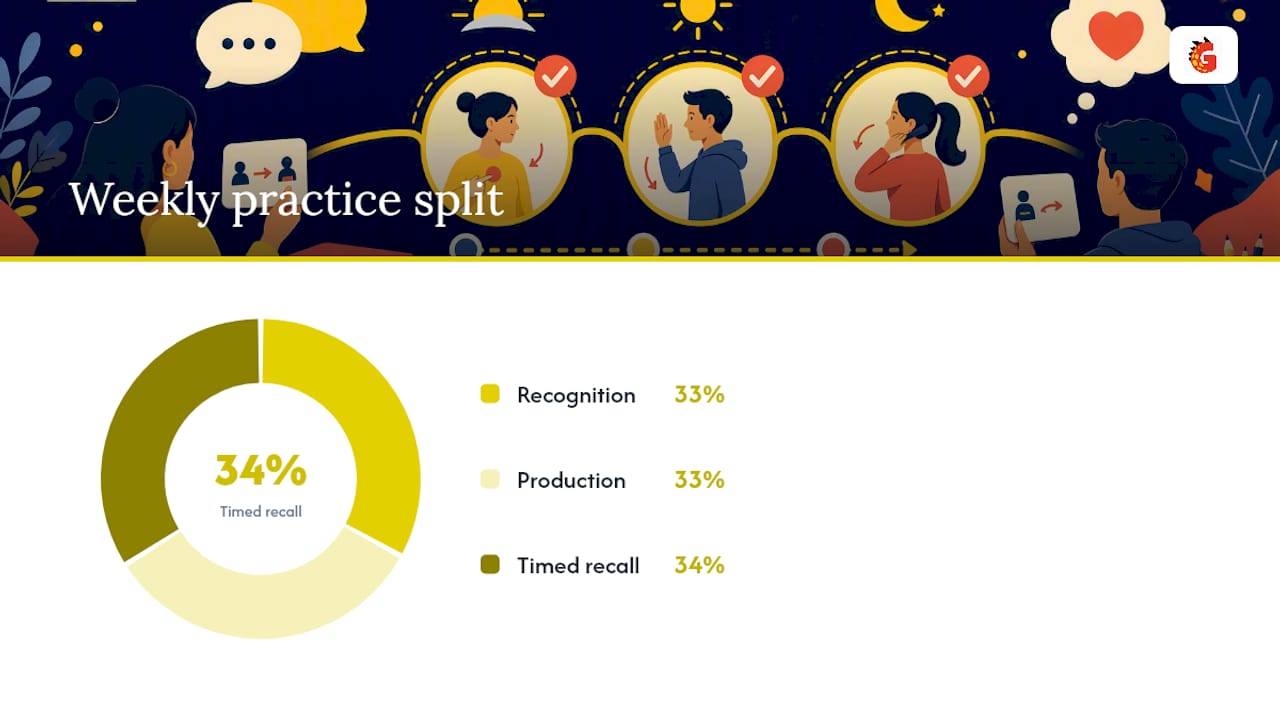
A realistic weekly plan looks like three ten-minute sessions: one for recognition (sorting verbs into categories), one for production (writing contrastive pairs), and one for timed speaking recall. Spacing those sessions across the week beats one long cram, since spaced repetition is what pushes a pattern from “I know the rule” to “I just said it correctly without thinking.”
Pro Tip: Keep a running list of only your mistakes, not every verb you encounter. Reviewing twenty sentences you personally got wrong builds automatic recall faster than reviewing two hundred you already knew.
Where Do Pronominal Verbs Come From?
Spanish inherited its reflexive pronoun system from Latin, where the reflexive pronoun se already marked actions the subject performed on itself. Over centuries, that marker did something Latin’s original system never fully did: it started attaching itself to verbs that had nothing literally reflexive about them.
Verbs like arrepentirse and quejarse trace back to Latin roots that were already shifting from purely transitive uses toward constructions where the subject experienced or underwent something rather than acted on an external object. As spoken Latin evolved into early Romance dialects, this pattern of using se to mark a change in the subject’s role, rather than a literal reflexive act, spread and solidified into the medio or anticausative construction Spanish uses today for verbs like romperse and abrirse.
By the medieval period, Spanish had developed a productive system where speakers could take a plain transitive verb and add se to signal a whole family of related meanings: reciprocity, emphasis, spontaneous change of state, or simply an intransitive reading. That flexibility is exactly why modern Spanish has so many alternating pairs. It’s not a modern grammatical quirk. It’s a linguistic habit centuries in the making, still actively used to coin new expressions today.
How Do Pronominal Verbs Behave in a Sentence?
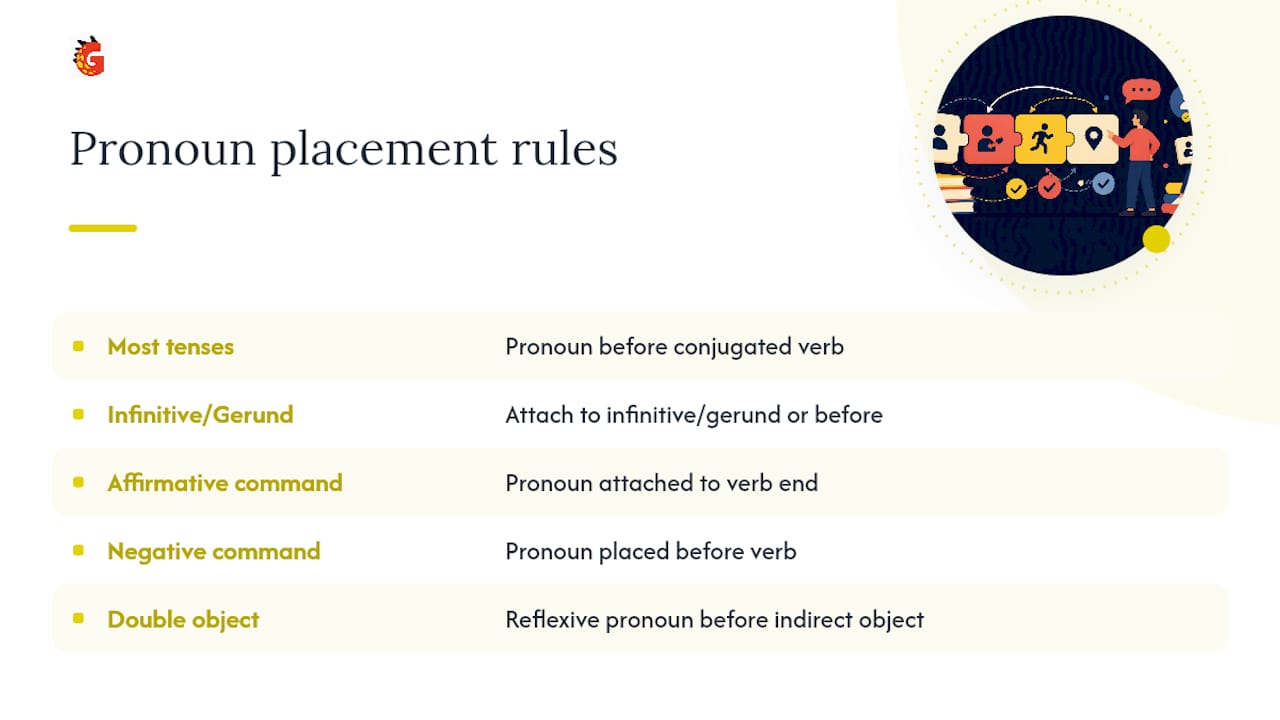
Word order around pronominal verbs follows rules that trip up learners coming from English, where reflexive pronouns trail the verb (“I wash myself”). Spanish puts the pronoun before the conjugated verb in most tenses: me lavo, te preocupas, se van.
With infinitives and gerunds, the pronoun can attach to the end of the verb form instead of standing alone before a helper verb. “Voy a levantarme” and “Me voy a levantar” mean exactly the same thing; only the pronoun’s position changes. The same flexibility applies to gerunds: “Está bañándose” and “Se está bañando” are interchangeable.
Commands split the rule further. Affirmative commands require the pronoun attached to the end of the verb: ¡Levántate! Negative commands push it back in front: ¡No te levantes! This single distinction accounts for a huge share of the pronoun-placement mistakes intermediate learners make, because the same verb flips its pronoun position depending on whether the command is a yes or a no.
Double object situations add one more layer. When a pronominal verb also takes an indirect object, the reflexive pronoun comes first: Se me olvidó la cita (I forgot the appointment, literally “the appointment forgot itself to me”). That construction, common with olvidarse, ocurrirse, and caerse, reorganizes the whole sentence around the thing being forgotten rather than the person forgetting it, which is precisely why direct translation from English so often fails here.
Do Pronominal Verbs Change Across Spanish Dialects?
The core grammar of pronominal verbs stays remarkably stable across the Spanish-speaking world, but which verbs actually get used pronominally, and how often, shifts noticeably by region and register.
Enfermarse is standard, everyday usage across most of Latin America, while speakers in Spain tend to say simply enfermar or ponerse enfermo. Demorarse (to take too long) is common pronominal usage in much of Latin America; in Spain, tardar usually does the job without a pronoun at all. These aren’t errors on either side. They’re regional preferences for which verbs default to a pronominal form.
Register matters too. In casual speech across many dialects, adding se to a verb can soften a command or add a conversational, almost intimate tone: Cómetelo (eat it up, said warmly) carries a different feel than the plain Come. That emphatic, cuasirreflexive use tends to show up more in relaxed spoken Spanish than in formal writing, where writers often prefer the non-pronominal form for precision.
For learners, the practical implication is this: don’t panic if you hear a verb used pronominally in one country and non-pronominally in another. Both are usually correct within their own dialect. What matters more for building real fluency is understanding the underlying mechanism, so you can adapt to whichever region’s Spanish you’re actually learning or living in.
How Do Other Romance Languages Handle Reflexive Verbs?
Spanish isn’t alone in building a whole grammatical system around reflexive pronouns, and comparing it to its Romance relatives makes the underlying logic clearer rather than more confusing.
French runs a nearly identical system with se: “se souvenir” (to remember) and “s’appeler” (to be called) are inherent pronominal verbs, just like acordarse and llamarse in Spanish. Italian does the same with si: “pentirsi” (to regret) mirrors arrepentirse almost exactly, right down to the semantic category of an inherently pronominal emotional verb. Portuguese uses se in much the same anticausative pattern Spanish does, so “a porta se abriu” and “la puerta se abrió” translate nearly word for word.
The pattern that unites all these languages traces back to the same Latin reflexive pronoun, which explains why a learner who already speaks French or Italian often picks up Spanish pronominal verbs faster than someone coming from English, where reflexive constructions are far more limited and never trigger the same kind of valency shift.
The differences show up mostly in which specific verbs each language chose to make pronominal over time, not in the grammatical mechanism itself. That’s a useful reminder that this isn’t some uniquely Spanish complication to fight through. It’s a shared Romance-language feature, and once the underlying logic clicks in one language, it tends to transfer to the others.
Turn This Explanation Into Real Speaking Instinct
Reading through classifications and diagnostic tests gets you knowledge. Getting me di cuenta and se me olvidó to come out of your mouth without a pause takes repetition, and that’s the gap Gramanator is built to close.

Gramanator runs you through structured drills that isolate exactly the patterns covered here: contrastive pairs like ir versus irse, valency shifts with verbs like olvidarse de, and pronoun placement across infinitives, gerunds, and commands. Every drill gives instant feedback, flags the mistake type, and tracks which pronominal patterns you keep missing so your next session targets those weak spots directly instead of recycling verbs you already know cold. That’s the same contrastive, mistake-focused approach that reduces transfer errors faster than memorizing lists, applied inside a structured A1 through C1 practice path rather than left to chance.
Start with a focused grammar workout built around pronominal verb alternations, or check the available plans to see which practice path fits your current level. Either way, the next step is the same: stop reading about the pronoun and start producing it under pressure.