Spanish opinion expression grammar for real-world use
If you think expressing opinions in Spanish is just a matter of saying creo que (“I think”) before any sentence, you are in for a surprise.

If you think expressing opinions in Spanish is just a matter of saying creo que (“I think”) before any sentence, you are in for a surprise. The grammar behind opinion expressions is far more layered than a direct translation suggests, and the difference between using the indicative and subjunctive moods can completely shift your meaning. Whether you are navigating a business meeting in Madrid, debating ideas with native-speaking colleagues, or simply trying to sound less robotic in conversation, understanding these structures is one of the most practical grammar skills you can build.
Table of Contents
- Understanding the basics of opinion expression grammar
- When to use the indicative vs. subjunctive mood
- Impersonal expressions: a powerful tool for opinions
- Expressing opinions confidently: practical usage examples
- What most learners get wrong (and how to fix it)
- Master Spanish opinion expressions with Gramanator
- Frequently asked questions
Key Takeaways
| Point | Details |
|---|---|
| Formula for impersonal opinions | Use ‘es + adjective + que + subjunctive’ to express non-personal judgments or necessities. |
| Mood selection matters | Choosing between indicative and subjunctive dramatically impacts meaning and confidence. |
| Real-world usage templates | Templates and examples help you apply opinion grammar in business and social discussions. |
| Avoid literal translations | Grammar patterns, not word-for-word translation, deliver clarity and nuance. |
| Practice for mastery | Repetition and feedback are key to mastering Spanish opinion expressions. |
Understanding the basics of opinion expression grammar
Now that we’ve established how misusing grammar can impact your clarity, let’s break down the basics of Spanish opinion expression grammar.
In English, expressing an opinion usually follows one simple pattern: “I think that...” or “I believe that...” You slot in your view, and the sentence works. Spanish is richer and more precise. The language requires you to choose specific verb moods depending on what kind of opinion you are stating, how certain you are, and whether you are speaking about yourself or making a general claim.
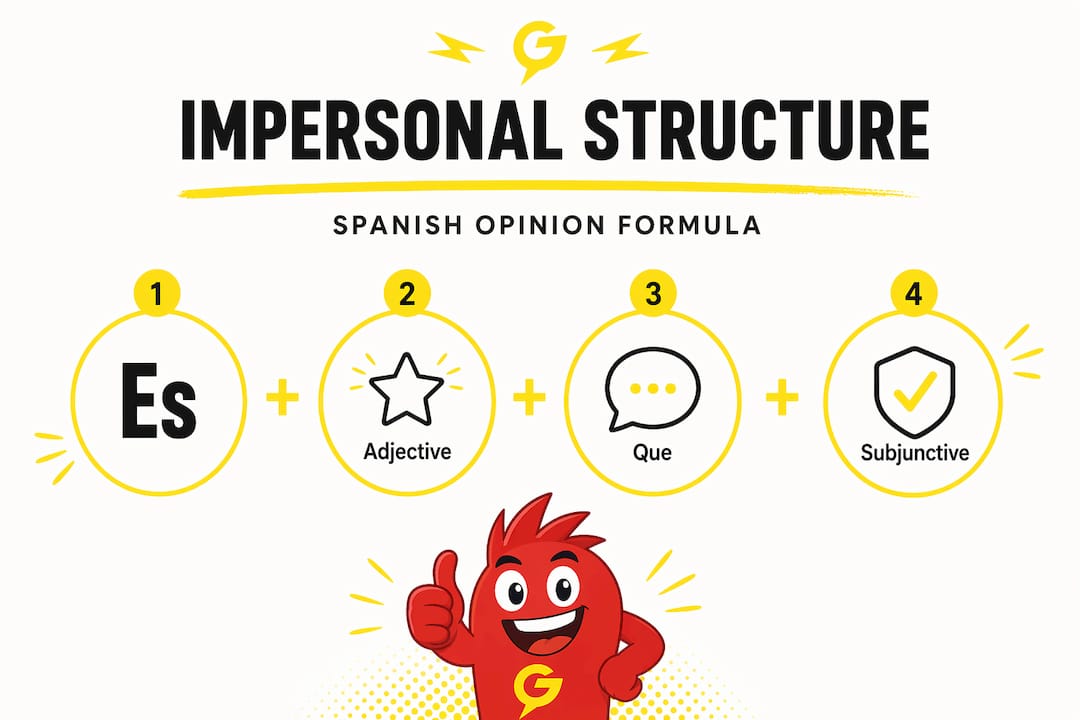
One of the most important patterns you need to know is the impersonal expression structure. According to impersonal expressions in Spanish, impersonal expressions for opinions follow the formula: es + adjective (masculine singular) + que + subjunctive. So instead of saying “I think it’s important,” you say Es importante que estudies (“It’s important that you study”). Notice that the verb estudiar shifts into the subjunctive form estudies. This structure removes the personal subject entirely and creates a more objective, authoritative tone.
This matters enormously in professional contexts. When you drop the personal subject from your opinion, you sound more diplomatic and less confrontational. It is a tool that fluent speakers use constantly, yet most intermediate learners skip right over it.
Here are some of the most common opinion phrases you will encounter, organized by structure:
- Creo que viene (“I believe he is coming”) - indicative, expresses certainty
- Es posible que venga (“It’s possible he comes”) - subjunctive, expresses possibility
- Me parece que tiene razón (“It seems to me he is right”) - indicative, personal opinion
- Es importante que lo hagas ahora (“It’s important that you do it now”) - subjunctive, impersonal
- Pienso que es una buena idea (“I think it’s a good idea”) - indicative, direct belief
- Es probable que llegue tarde (“It’s likely he’ll arrive late”) - subjunctive, probability
You can explore more patterns and Spanish grammar practice on Gramanator’s platform, which categorizes these structures by context and difficulty level. The Spanish grammar blog also offers deeper dives into specific grammar rules with real-world examples.
The core takeaway here: Spanish opinion grammar is not about memorizing phrases in isolation. It is about understanding the system behind them so you can generate new sentences correctly on your own.
When to use the indicative vs. subjunctive mood
Understanding the basic forms allows us to explore how mood choice can signal certainty or doubt.
This is where many learners feel the most confusion. The rule is logical once you see it clearly: use the indicative when you are expressing a firm belief or stating what you consider to be true; use the subjunctive when you are expressing doubt, possibility, or something that is not yet certain.

Here is a quick side-by-side comparison to make this concrete:
| Phrase | Mood | Meaning |
|---|---|---|
| Creo que viene | Indicative | “I believe he is coming” (confident) |
| No creo que venga | Subjunctive | “I don’t think he’s coming” (doubt) |
| Es posible que venga | Subjunctive | “It’s possible he comes” (uncertain) |
| Es obvio que viene | Indicative | “It’s obvious he’s coming” (certain) |
| Me parece que sabe la verdad | Indicative | “It seems to me he knows the truth” (belief) |
| Es necesario que sepas esto | Subjunctive | “It’s necessary that you know this” (impersonal) |
Notice the pattern: negating an opinion verb like creer or pensar flips you into the subjunctive. When you say no creo que, you are now expressing doubt rather than certainty, so the subjunctive is required. This is a rule that catches learners off guard because the verb itself is the same, but its negation changes the grammar entirely.
Here is a step-by-step process to determine which mood to use:
- Identify the opinion verb or expression. Is it creer, pensar, es posible, es importante, or similar?
- Check if it’s affirmative or negative. Affirmative forms of creer and pensar typically use the indicative; negated forms use the subjunctive.
- Ask whether the statement expresses certainty or doubt. Certainty points to indicative; doubt, possibility, or necessity points to subjunctive.
- Check if it’s an impersonal expression. Impersonal structures almost always require the subjunctive regardless of affirmation.
- Verify the conjugation. Make sure the second verb is correctly conjugated in present subjunctive or whichever tense applies.
You can apply this same framework to any opinion sentence. With practice, the mood selection becomes intuitive rather than a calculation.
Pro Tip: There are edge cases worth knowing. Questions using opinion verbs can sometimes require the subjunctive when the speaker implies genuine uncertainty. For example, as noted in discussions of subjunctive and opinions, a question like ¿Crees que venga? implies you genuinely doubt whether it will happen, whereas ¿Crees que viene? treats the outcome as more likely. Both are grammatically valid, but they carry different emotional weight.
If you want to sound like a confident, nuanced speaker, studying this distinction in depth is essential. The ser vs estar guide on Gramanator’s blog shows how a similar logic of certainty vs. state applies to other major grammar areas in Spanish.
Impersonal expressions: a powerful tool for opinions
With mood selection clarified, let’s look at a special category of opinion expressions that boost nuance: impersonal structures.
Impersonal expressions are sentences that make no reference to a specific subject. Instead of “I think it’s necessary,” you say Es necesario que... (“It’s necessary that...”). This structure is incredibly common in formal writing, professional speech, and academic Spanish. Mastering it immediately elevates the register of your communication.
As detailed in the complete lesson on impersonal expressions, these structures always follow the pattern es + adjective + que + subjunctive, as in Es posible que llueva (“It’s possible that it will rain”) and Es importante que estudies (“It’s important that you study”). The adjective stays in masculine singular form regardless of context.
Here is a data table of the most useful impersonal expressions for opinion:
| Spanish expression | English translation | Type of opinion |
|---|---|---|
| Es posible que... | “It’s possible that...” | Possibility |
| Es probable que... | “It’s likely that...” | Probability |
| Es necesario que... | “It’s necessary that...” | Necessity |
| Es importante que... | “It’s important that...” | Importance |
| Es bueno que... | “It’s good that...” | Value judgment |
| Es extraño que... | “It’s strange that...” | Surprise or doubt |
| Es una lástima que... | “It’s a shame that...” | Regret |
| Es mejor que... | “It’s better that...” | Recommendation |
These structures are not just grammar exercises. They appear constantly in real life. Here are specific situations where impersonal expressions come up naturally:
- In office meetings: Es importante que revisemos los datos antes de la presentación. (“It’s important that we review the data before the presentation.”)
- In academic discussions: Es necesario que citemos fuentes confiables. (“It’s necessary that we cite reliable sources.”)
- In polite disagreement: Es posible que haya un malentendido. (“It’s possible that there is a misunderstanding.”)
- In travel scenarios: Es mejor que reserves el hotel con antelación. (“It’s better that you book the hotel in advance.”)
Impersonal expressions give Spanish speakers a grammatically precise way to express opinions without attributing the view to any single person. This makes them ideal for diplomatic, professional, and academic communication, where tone and credibility matter as much as content.
When you use these structures confidently, native speakers immediately notice a higher level of fluency. You can find structured practice targeting exactly these patterns through the grammar tips and examples section on Gramanator’s platform.
Expressing opinions confidently: practical usage examples
Having mastered forms and nuance, here’s how you can confidently use opinion expressions in everyday and professional contexts.
Theory matters, but practice is where the grammar becomes second nature. Let’s look at how these structures work in three common scenarios: business communication, academic settings, and social conversation.
The most important advice here is to stop translating from English. When you think “I believe this plan is risky,” do not build from the English sentence. Instead, reach for the Spanish structure directly: Creo que este plan es arriesgado. If you want a softer, more impersonal tone: Es posible que el plan conlleve ciertos riesgos. Both are correct, but one is blunt and personal while the other is measured and diplomatic.
Here are ready-to-use templates for three scenarios:
Business and professional contexts:
- Me parece que deberíamos reconsiderar esta propuesta. (“It seems to me we should reconsider this proposal.”)
- Es importante que el equipo tenga información actualizada. (“It’s important that the team has updated information.”)
- Creo que hay una solución más eficiente. (“I believe there is a more efficient solution.”)
Academic and formal writing:
- Es necesario que los investigadores sigan protocolos éticos. (“It’s necessary that researchers follow ethical protocols.”)
- Es probable que los resultados varíen según el contexto. (“It’s likely that results will vary depending on context.”)
- Pienso que este argumento necesita más evidencia. (“I think this argument needs more evidence.”)
Social and everyday conversation:
- Creo que esa película es excelente. (“I think that movie is excellent.”)
- Me parece que hace demasiado calor hoy. (“It seems too hot to me today.”)
- Es una lástima que no puedas venir a la cena. (“It’s a shame you can’t come to dinner.”)
Pro Tip: A very common translation trap is rendering “I think so” as Creo que sí rather than the incorrect Pienso así. Similarly, “I don’t think so” becomes Creo que no, not No pienso. These tiny differences are easy to get right once you know them, but they trip up even advanced learners who rely on literal translation. As reinforced by the impersonal expressions lesson, pattern-based practice is one of the most effective ways to internalize these structures.
Consistent repetition of these templates within realistic contexts is what builds fluency. You can start practicing Spanish grammar immediately with exercises built around exactly these kinds of real-world opinion scenarios.
What most learners get wrong (and how to fix it)
Let’s be direct: most intermediate Spanish learners lean too heavily on creo que for everything. It is the “I think” of Spanish, familiar and easy, so it becomes a crutch. The result is speech that sounds repetitive and lacks the nuance that native speakers express so naturally.
Using creo que exclusively also means defaulting to the indicative mood in situations where the subjunctive is not just preferred but required. If you say Creo que sea mejor así when you mean a confident belief, you are actually signaling doubt or hedging unnecessarily. Conversely, if you say Es posible que viene instead of venga, you have mixed moods and the sentence sounds grammatically off to any native speaker.
Another underused tool is the range of impersonal expressions. Learners who avoid them miss out on an entire register of Spanish. These structures are everywhere in professional and academic Spanish. Ignoring them keeps your speech at a social, informal level even when the situation calls for something more precise.
The fix is not complicated, but it does require deliberate practice. Pattern drills that force you to switch between indicative and subjunctive based on context are far more effective than reading grammar rules passively. You need to produce the structures repeatedly until the mood choice becomes automatic rather than analytical. Contextual practice, where you apply the grammar to realistic scenarios like workplace discussions or travel conversations, builds the kind of fluency that sticks.
You can sharpen these skills quickly through advanced grammar tips and structured exercises on Gramanator. The platform is designed to give you immediate feedback on exactly these kinds of mood choices, so you stop second-guessing yourself and start communicating with genuine confidence.
Master Spanish opinion expressions with Gramanator
Ready to take your understanding to fluent expression? Here’s your next step for mastering this skill hands-on.
Grammar explanations can only take you so far. Real mastery comes from applying these structures in practice, getting feedback, and seeing your patterns improve over time. That is precisely what Gramanator is built for.

Gramanator’s AI-powered platform offers over 10,000 structured exercises targeting real grammar points, including the indicative vs. subjunctive mood choices and impersonal expressions that define confident opinion communication. You get immediate, detailed feedback on every answer, with explanations that address exactly what went wrong and why. Exercises are tied to realistic scenarios such as office conversations, academic discussions, and travel situations, so the grammar you practice is grammar you will actually use. You can start Spanish grammar practice today and track your progress from your first session. Check out Spanish grammar pricing to find the plan that fits your learning goals and schedule.
Frequently asked questions
What is the structure of impersonal opinion expressions in Spanish?
Impersonal opinion expressions follow the formula “es + adjective + que + subjunctive”, making statements about necessity, possibility, or importance without referencing a personal subject.
When do I use the subjunctive for opinions?
Use the subjunctive mood when your opinion implies doubt, possibility, or indirectness, such as in uncertain questions or impersonal expressions like es posible que or no creo que.
Can creo que ever require the subjunctive?
Creo que generally uses the indicative for statements of certainty, but it shifts to subjunctive when posed as a question that implies genuine doubt, such as ¿Crees que venga?
How do opinion expressions improve professional communication in Spanish?
Using correct opinion grammar, especially impersonal expressions and the right verb mood, enhances your clarity, diplomatic tone, and overall credibility in any workplace or formal setting.
What is a common mistake with opinion grammar?
Many learners confuse indicative and subjunctive moods by applying one where the other is needed, which results in statements that either sound overconfident or accidentally uncertain to native Spanish speakers.