Master Spanish meeting vocabulary for confident work
Spanish meeting vocabulary and grammar for work. Phrases to open, contribute, disagree politely, and wrap up in Spain and Latin America.

Master Spanish meeting vocabulary for confident work
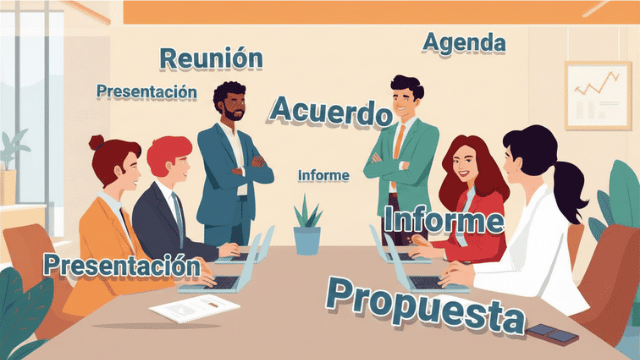
You know the feeling. You have studied Spanish for months, maybe years, and then a meeting starts and your mind goes blank. Someone asks for your opinion, the room turns to you, and suddenly every phrase you practiced disappears. This is not a vocabulary problem alone. It is a context problem. Most learners spend time memorizing word lists without understanding how those words function inside the rhythm of a real workplace meeting, where etiquette, formality, and cultural expectations shape every sentence. This article gives you a practical, structured roadmap to fix that gap for good.
Table of Contents
- Why meeting vocabulary matters for Spanish-speaking workplaces
- Core Spanish meeting vocabulary and how it is structured
- Etiquette, formality, and regional nuance: What most learners miss
- Applying vocabulary: Building and rehearsing your Spanish phrase bank
- What years of experience reveal about mastering meeting Spanish
- Next steps: Practice Spanish meeting skills with Gramanator
- Frequently asked questions
Key Takeaways
| Point | Details |
|---|---|
| Phrase banks drive fluency | Organizing and rehearsing phrases by meeting role helps you respond automatically in Spanish meetings. |
| Etiquette affects word choice | Proper formality and regional awareness shape which Spanish phrases will be effective and respectful. |
| Chunk, don’t translate | Practicing whole phrases-rather than picking words-avoids awkward moments and lets you sound more natural. |
| Listen for cues | Pay attention to how others use ‘usted’ and ‘tú’ so you can match the level of formality confidently. |
| Regular practice is key | Consistent rehearsal and real-world use accelerate comfort in high-stakes meetings. |
Why meeting vocabulary matters for Spanish-speaking workplaces
Spanish-speaking workplaces are not just places where Spanish happens to be spoken. They carry their own professional culture, and that culture shapes the language people use every single day. If you walk into a meeting with a word list and no cultural framework, you will likely use the right words in the wrong way, and that creates friction.
Consider this: in many Spanish-speaking countries, meetings serve a relational purpose as much as a task-oriented one. Building confianza (trust) through small talk before the agenda begins is not wasted time. It is expected. Business meetings in Spain show that relationship-first approaches and regional differences in punctuality and work rhythm directly affect which phrases you will use most, whether those are softeners, relationship-building language, or more direct steering phrases.
“The phrases you need most in a Spanish meeting are not always the ones in a textbook. They are the ones that signal respect, build rapport, and keep the conversation moving in a culturally appropriate way.”
Here is what that means practically. The vocabulary you need changes depending on:
- The country or region. A meeting in Mexico City may feel warmer and more relationship-focused than one in Madrid, where directness is more common in corporate settings.
- The company culture. Startups often use tuteo (the informal tú form) from day one, while traditional firms may stick with usted for months.
- Your role in the meeting. Facilitators need steering phrases. Participants need floor-taking language. Both need polite ways to disagree.
- The meeting type. A status update meeting calls for concise reporting language. A brainstorming session needs phrases that invite ideas and build on contributions.
Understanding these layers is what separates a confident Spanish speaker from one who freezes mid-sentence.
Core Spanish meeting vocabulary and how it is structured
Now that you understand why vocabulary choice matters, let us break down the actual language structure used in real meetings. The good news is that meeting vocabulary is not random. It maps onto predictable stages, and once you know those stages, you can prepare targeted phrases for each one.
A typical Spanish meeting moves through five phases: opening, agenda setting, discussion, decision-making, and closing. Each phase has its own communicative tasks, and each task has a set of phrases that native speakers reach for automatically. Your goal is to build that same automatic reach.
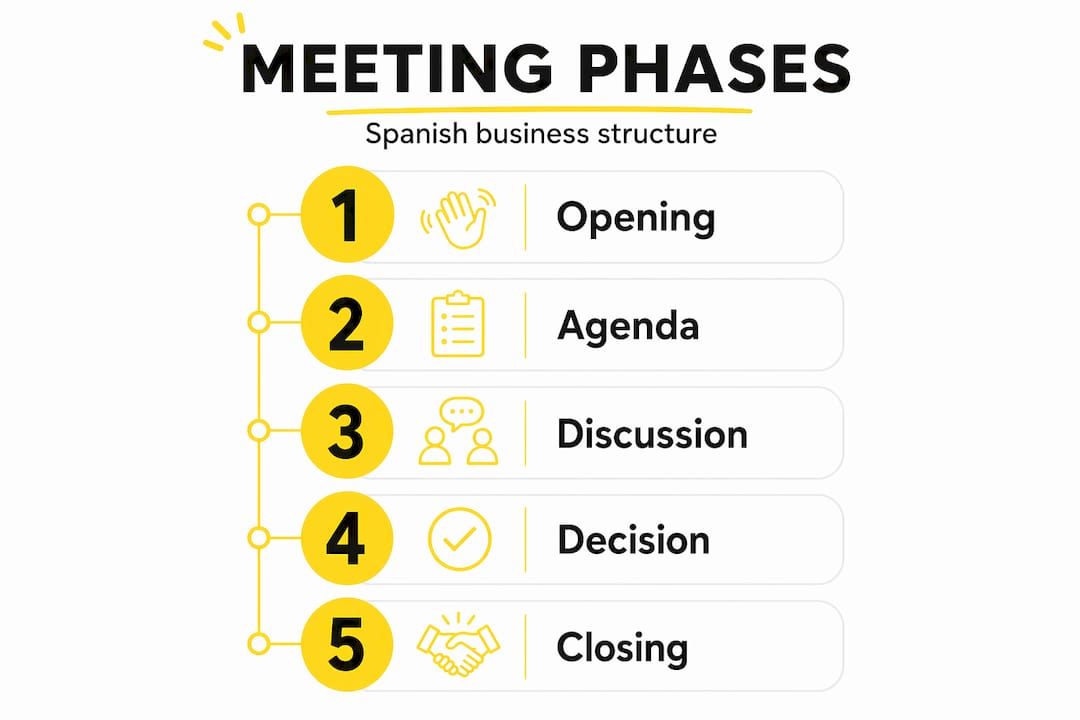
Here is a practical overview:
| Meeting phase | Communicative task | Example phrase |
|---|---|---|
| Opening | Greet and set tone | Buenos días a todos. Gracias por estar aquí. |
| Agenda setting | Introduce topics | El orden del día incluye tres puntos. |
| Discussion | Take the floor | Si me permiten, quisiera añadir algo. |
| Discussion | Soften disagreement | Entiendo su punto, aunque me pregunto si... |
| Decision-making | Propose a decision | ¿Podríamos acordar que...? |
| Closing | Summarize next steps | Para resumir, los próximos pasos son... |
The strategy here is to build a phrase bank mapped to meeting tasks such as agenda items, floor-taking, questions, summarizing, and next steps, and then rehearse those phrases as complete chunks rather than translating word by word in the middle of the meeting. This approach, called chunking, treats a phrase like “Si me permiten, quisiera añadir algo” as a single unit of meaning, not a string of individual words to decode on the fly.
Chunking works because your brain stores and retrieves language in patterns. When you have rehearsed a chunk enough times, it becomes automatic. You stop thinking about grammar mid-sentence and start thinking about your message. That is when you truly participate, not just survive.
Key phrase categories to build first:
- Agreeing: Estoy de acuerdo. / Exactamente. / Tiene razón.
- Disagreeing politely: Entiendo su perspectiva, sin embargo... / Con todo respeto, creo que...
- Asking for clarification: ¿Podría explicar eso con más detalle? / ¿A qué se refiere exactamente?
- Buying time: Déjeme pensar un momento. / Es una buena pregunta.
- Summarizing: En resumen... / Para concluir... / Los puntos clave son...
Pro Tip: Check out grammar tips on Gramanator’s blog for deeper explanations of the subjunctive mood and conditional tenses, both of which appear frequently in polite business phrases. Understanding why “quisiera” sounds more polite than “quiero” will help you use these chunks with real confidence.
You can also explore ser vs estar explained to understand how identity and state affect professional descriptions. Saying “La reunión está bien organizada” versus “La reunión es bien organizada” carries a meaningful difference that native speakers notice immediately.
Etiquette, formality, and regional nuance: What most learners miss
With the core structure mapped, the next crucial element is adapting to social and regional norms so you sound professional and respectful. This is the layer most learners skip entirely, and it is often the reason they plateau.
Spanish has two registers for addressing people directly: usted (formal) and tú (informal). Choosing the wrong one is not just a grammar mistake. It signals a misread of the social situation. In a meeting with senior colleagues or external clients, using tú too early can come across as presumptuous. Using usted when everyone else has shifted to tú can make you seem stiff or distant.
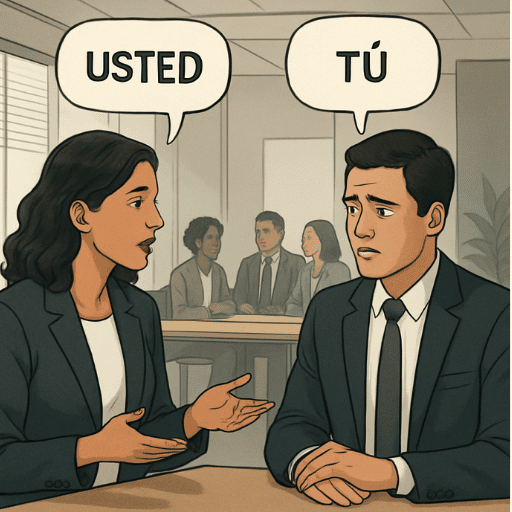
A practical benchmark for expatriates: default to usted-based phrasing when first interacting in a workplace meeting, and wait until your counterpart signals a shift to tú before adjusting. This is especially important in multi-country teams where norms vary widely.
Here is a side-by-side comparison to help you navigate:
| Situation | Recommended form | Example |
|---|---|---|
| First meeting with client | Usted | ¿En qué puedo ayudarle? |
| Internal team with senior staff | Usted until invited otherwise | ¿Tiene alguna pregunta? |
| Startup or young team | Tú often acceptable | ¿Tienes alguna pregunta? |
| Latin American corporate setting | Usted is safer | ¿Le parece bien esta propuesta? |
| Spain, informal company culture | Tú common early | ¿Te parece bien? |
How to read the room in four steps:
- Listen to how others address each other in the first five minutes. If colleagues use tú freely, you can follow their lead.
- Watch for invitations. A phrase like “Puedes tutearme” (you can use tú with me) is a clear green light.
- Mirror the most senior person’s register. If the director uses usted with you, match it.
- When in doubt, stay formal. No one has ever been offended by respectful language.
Regional meeting etiquette details also affect timing, small talk, and how decisions are communicated. In Argentina, meetings may start a bit later than scheduled and include more personal conversation. In Chile, punctuality tends to be taken more seriously in formal corporate settings. In Spain, a post-meeting coffee conversation can be just as important as the meeting itself.
Pro Tip: When you plan your learning on Gramanator, you can target grammar structures tied to formal registers, including the subjunctive in polite requests and conditional forms for softened suggestions. These are not just grammar rules. They are the building blocks of professional Spanish.
Applying vocabulary: Building and rehearsing your Spanish phrase bank
Now that etiquette is clear, here is how you go beyond passive learning to real, confident meeting participation. The phrase bank method works because it connects language to function. Instead of memorizing random vocabulary, you practice language that does something specific in a meeting.
Follow these steps to build yours:
-
List your recurring meeting tasks. Think about what you actually do in meetings: introduce yourself, present data, ask questions, propose solutions, summarize decisions. Write down five to eight tasks specific to your role.
-
Match two to three phrases to each task. For example, if your task is “asking for clarification,” your phrases might be: “¿Podría repetir eso, por favor?”, “¿Me podría dar un ejemplo?”, and “No estoy seguro de haber entendido bien. ¿Podría aclarar?”
-
Rehearse aloud, not just in your head. Speaking activates different cognitive processes than reading. Say each phrase out loud at least ten times. Record yourself if possible and listen back. This builds the muscle memory that silent study never creates.
-
Use shadowing to simulate real meetings. Find recordings of Spanish business meetings or professional presentations online. Listen to a sentence, pause, and repeat it with the same rhythm, intonation, and speed. Shadowing trains your ear and your mouth simultaneously.
-
Role-play with a partner or tutor. Simulate a meeting scenario where you have to use phrases from your bank. The pressure of a real conversation, even a practice one, forces your brain to retrieve language faster and more accurately.
-
Review and rotate. Every two weeks, revisit your phrase bank. Add new phrases you have encountered in real meetings. Remove ones that feel completely automatic. Keep the bank fresh and relevant to your current challenges.
The key insight from rehearsing as chunks rather than translating word by word is that fluency is not about knowing more words. It is about retrieving the right phrase at the right moment without hesitation.
Pro Tip: Use Gramanator’s practice tools to reinforce the grammar patterns inside your chunks. When you understand why “quisiera que se considerara” uses the subjunctive, you can adapt the phrase confidently to new situations instead of relying on a memorized script.
What years of experience reveal about mastering meeting Spanish
Here is something worth saying plainly: most professionals who struggle in Spanish meetings are not struggling because they know too little vocabulary. They are struggling because they have practiced the wrong way. Passive study, reading lists, and translation exercises build recognition. They do not build production.
The chunked rehearsal method works better than simple memorization for one fundamental reason. When you rehearse a complete phrase tied to a specific communicative task, you are training your brain to link a situation to a response. That link is what fires automatically when you are in a real meeting and someone asks for your input. You do not search for words. You reach for a chunk.
Most professionals also underestimate how much culture-specific knowledge is embedded in language. A phrase like “Con todo respeto, me parece que...” (With all due respect, it seems to me that...) is not just polite. It signals that you understand the social contract of Spanish professional communication. It tells your colleagues that you can navigate disagreement without causing offense. That kind of signal builds professional credibility fast.
The uncomfortable truth is that consistent, task-based practice with real feedback outperforms any amount of passive study. Reading about Spanish meeting vocabulary is a start. Rehearsing it, getting corrections, and applying it in context is what actually moves the needle. If you want to see real progress, look at grammar insights that connect structure to real-world use, and commit to active practice every single week.
Next steps: Practice Spanish meeting skills with Gramanator
You now have a clear framework: understand the cultural context, map vocabulary to meeting phases, respect formality signals, and rehearse in chunks. The next step is putting that framework into consistent, structured practice.
Gramanator’s platform is built exactly for this kind of learning. With over 10,000 interactive grammar exercises tied to real-world scenarios including workplace communication, you can practice the subjunctive forms in polite requests, conditional structures for softened suggestions, and formal register patterns that make your meeting Spanish sound natural and professional. Detailed progress tracking shows you exactly where your strengths and gaps are, so you always know what to work on next. Explore affordable Spanish grammar plans and start building the meeting Spanish that gets you noticed for the right reasons.
Frequently asked questions
What is the most polite way to speak in a Spanish business meeting?
Begin with usted forms and formal greetings until invited to use tú or more informal phrasing. Default to usted-based phrasing in your first interactions, especially in multi-country teams where norms vary significantly.
How do I organize a Spanish phrase bank for meetings?
Group phrases by meeting tasks such as introductions, questions, agenda items, and closing, and practice each chunk aloud. Rehearsing phrases as chunks mapped to specific tasks builds faster, more reliable retrieval than memorizing isolated words.
Are there regional differences in Spanish business meeting etiquette?
Yes, approaches to formality, punctuality, and relationship-building language vary widely by country and region. Regional differences in Spanish business practice directly affect which phrases you will use most, from softeners to direct steering language.
Why do direct word-for-word translations fail in meetings?
Literal translations miss the context and politeness strategies embedded in Spanish business communication. The most effective approach is to rehearse phrases as chunks rather than translating word by word mid-meeting, which slows you down and often produces unnatural results.
What’s the fastest way to sound more natural in Spanish meetings?
Use chunked, situation-appropriate phrases mapped to meeting sections and practice them aloud consistently. Rehearsing complete chunks tied to specific meeting tasks trains your brain to retrieve language automatically, which is what natural fluency actually feels like in practice.
Recommended
- Top 6 Best App for Spanish Grammar Alternatives 2026
- Spanish Verb Conjugation Rules: Your Complete 2026 Guide