Mass Regularización in Spain 2026: what happens now & the Spanish you need
Spain's 2026 mass regularization deadline is June 30. Learn what it means, the next steps for applicants, and the Spanish vocabulary you need for papeleo oficial.
:::highlight
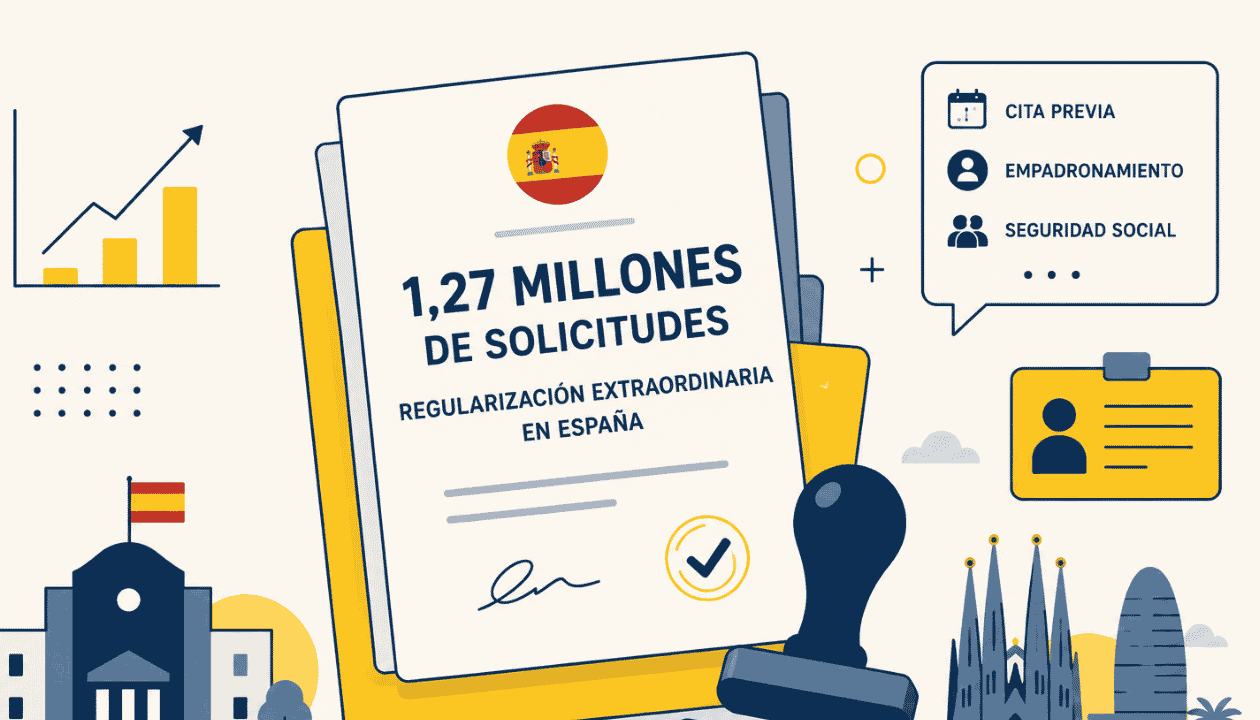
**Quick answer:** Spain's extraordinary mass *regularización* closes today, June 30, 2026. [Applications surged to 1.27 million](https://www.reuters.com/world/americas/spanish-ngos-push-undocumented-migrants-apply-regularisation-deadline-looms-2026-06-29/) by the deadline. If your application was admitted, you can already work legally - the final resolution comes within ~3 months, with *silencio administrativo* as the fallback rule. From here, the real challenge is the Spanish of *papeleo oficial*: the formal vocabulary you'll use at the [*ayuntamiento*](https://www.barcelona.cat/infobarcelona/en/tema/service-information/informacio-sobre-la-regularitzacio-extraordinaria-per-a-persones-migrades-del-govern-espanyol_1597072.html), *Seguridad Social* and *oficina de extranjería*.
:::
## Why this regularización matters
Today, **June 30, 2026**, is the last day to apply for Spain's extraordinary mass *regularización*. After tonight the door closes - Royal Decree 316/2026 set this deadline with no possibility of extension. If you've already submitted, or you're racing to file in the next few hours, this guide walks you through what the *regularización* actually is, what happens next, and - just as importantly - the Spanish you'll need for the *papeleo* ahead as you build your life in Spain.
## What the mass regularización actually is
Spain's 2026 extraordinary *regularización* is the [**seventh** mass legalization process the country has carried out since 1986](https://www.infomigrants.net/en/post/71024/how-spains-2026-regularization-works), and the largest yet. Approved by the Council of Ministers on April 14, 2026 and published in the *BOE* the next day, it created a new, time-limited *arraigo* (residence pathway) for two main groups:
- People living in Spain without legal status before January 1, 2026.
- *Solicitantes de asilo* (asylum seekers) who had filed their applications before that date.
## Who could apply and what it grants
To qualify, applicants generally had to prove:
- Presence in Spain before January 1, 2026.
- At least **five months** of continuous residence.
- No criminal record, and no entry ban for Spain or Schengen.
The *regularización* grants a [**one-year residence and work permit**](https://balcellsgroup.com/mass-regularization/) for adults (five years for minor children included in a family application). The crucial detail: from the moment an application is *admitida a trámite* (admitted for processing) - not the final resolution - the applicant can already **work legally**, access *sanidad pública*, and have any pending expulsion procedure suspended. The Spanish government has initially estimated the measure could benefit between **500,000 and 800,000 people**.
## Today is the deadline - what happens next
If you applied before today, here's the realistic timeline:
| Stage | What it means |
|------|---------------|
| *Admisión a trámite* | Your file is officially registered. Provisional work authorization kicks in - you don't wait for the final answer. |
| Up to 3 months for a *resolución* | Immigration offices are handling close to half a million cases, so delays are expected. |
| *Silencio administrativo* | If three months pass with no answer, the application is legally considered rejected - but this opens the door to an *recurso* (appeal), and your provisional work authorization stays valid while you wait. |
| Final decision | If approved, you receive your *permiso de residencia* and the physical *TIE* card, and must register with *Seguridad Social* within one month. |
| Denial | You can appeal through administrative or judicial channels, but the provisional work authorization is lost and you must inform your employer immediately. |
If you missed today's deadline, this extraordinary route is gone - the only paths forward are the ordinary *arraigo social* or *arraigo laboral*, which require two or more years of documented residence.
{{cta:mid}}
## The real challenge starts now: integrating into Spanish life
Getting the permit is just the first step. The point of *regularización* is **integration** - moving from the margins of Spanish society into its everyday institutions: the *empadronamiento*, the job market, the healthcare system, schools, banks, and eventually long-term residence or even *nacionalidad*. Nearly every one of those steps happens, at some point, in Spanish - and often in a formal, official-sounding Spanish that is very different from what you hear on the street.
This is where many newly regularized residents hit a wall: not because they don't know Spanish, but because they've never practiced the specific vocabulary and sentence structures used in government offices, on official forms, and in formal calls or emails.
## Vocabulary and wording you'll actually need
Here are the words that come up constantly once you start dealing with Spanish bureaucracy. Learn them as **fixed pairs** - the Spanish term alongside the situation it belongs to.
### Key nouns
| Spanish | English |
|---------|---------|
| *el trámite* | the procedure / formality |
| *la cita previa* | the prior appointment |
| *el empadronamiento* | municipal registration |
| *el permiso de residencia* / *el permiso de trabajo* | residence permit / work permit |
| *la solicitud* | the application |
| *el certificado de antecedentes penales* | criminal record certificate |
| *el contrato de trabajo* | employment contract |
| *la Seguridad Social* | Social Security |
| *el padrón* | the local census / registry |
| *el resguardo* / *el justificante* | the receipt / proof of submission |
| *la oficina de extranjería* | the immigration office |
| *la gestoría* | a paperwork agency that handles trámites for you |
### Key verbs and set phrases
| Spanish | English | Note |
|---------|---------|------|
| *solicitar* | to apply for | **False friend:** *aplicar para* is not natural Spanish here - use *solicitar*. |
| *rellenar un formulario* | to fill out a form | Not *llenar* in this register. |
| *presentar la documentación* | to submit documentation | The verb of choice in any office. |
| *pedir cita* | to book an appointment | Often online via *Sede Electrónica*. |
| *empadronarse* | to register at your local town hall | Reflexive - *me empadroné en Madrid*. |
| *darse de alta* (en la Seguridad Social) | to register / enroll | Reflexive; its opposite is *darse de baja*. |
| *estar pendiente de resolución* | to be awaiting a decision | The standard status phrase. |
| *adjuntar un documento* | to attach a document | Used in formal emails. |
## Formal sentence patterns you'll reuse constantly
These are not phrases you pick up from chatting with friends - they live in forms, emails and government websites. Using the wrong *register* (too casual, or grammatically off) can make a simple errand feel a lot harder than it should.
> *Quisiera solicitar una cita previa.* - "I would like to request an appointment."
> *¿Podría confirmarme si mi solicitud ha sido admitida a trámite?* - "Could you confirm whether my application has been admitted for processing?"
> *Adjunto la documentación requerida.* - "I attach the required documentation."
> *Quedo a la espera de su respuesta.* - "I await your reply."
> *Le escribo en relación con el expediente número...* - "I am writing in reference to file number..."
Notice the pattern: *usted* forms, conditional politeness (*quisiera*, *podría*), and verbs like *adjuntar*, *solicitar*, *quedar a la espera* that almost never appear in casual conversation.
## How Gramanator helps you practice this
This is exactly the kind of real-life Spanish Gramanator is built for. Instead of generic vocabulary lists, Gramanator trains you with structured drills until grammar and vocabulary become instinct - so you're not translating in your head while standing in line at the *oficina de extranjería*.
{{image:1}}
At the **A2** level, inside the *Inmigración / Trámites* block, you'll find a dedicated set of exercises built specifically to help you **hacer papeleo oficial** with confidence. You'll practice:
- The vocabulary above **in context**, not as flat word lists.
- The sentence structures used in forms and formal requests.
- The grammar that trips people up most here: *quisiera*, formal *usted* constructions, and the prepositions that go with verbs like *solicitar*, *adjuntar* and *darse de alta*.
Whether you're filling out your *cita previa*, writing an email to your *gestoría*, or preparing for an appointment at *Seguridad Social*, a little focused practice now means you walk in **ready** - not guessing.
## Recommended reading
Keep building on this guide with related Gramanator articles and learning resources:
- [Spanish cultural context grammar: your fluency guide](/blog/spanish-cultural-context-grammar-your-fluency-guide) - why grammar choices reflect Spanish cultural norms.
- [What is Spanish customer service grammar? A complete guide](/blog/what-is-spanish-customer-service-grammar-a-complete-guide) - the same formal register, applied to calls and emails.
- [Spanish job interview grammar: what you need to know](/blog/spanish-job-interview-grammar-what-you-need-to-know) - turn your new work permit into a job you can hold a conversation about.
- [What is A1 grammar level Spanish: a beginner's guide](/blog/what-is-a1-grammar-level-spanish-a-beginners-guide) - the level where the *Inmigración / Trámites* block lives.
- [Spanish family conversation grammar: adult learner's guide](/blog/spanish-family-conversation-grammar-adult-learners-guide) - everyday Spanish for life outside the office.
- [Browse all Gramanator topics](/topics) - find the exact A1-B2 block that fits your next *trámite*.
## In short
Spain's 2026 mass *regularización* closes its application window today, June 30. For everyone who applied, the next real milestone isn't the resolution letter - it's everyday life in Spain: registering, working, opening accounts, dealing with official letters. Gramanator's A2 *Inmigración / Trámites* block exists precisely for that moment, so the Spanish of *papeleo oficial* stops being intimidating and starts being automatic.